What Makes 4C Hair Different
A good 4c hair routine starts with understanding what makes this curl pattern unique. 4C hair has the tightest curl pattern of all, with dense, zig-zag coils that shrink dramatically — often up to 70% or more of the hair’s true length. That shrinkage is not damage; it is simply how 4C hair behaves. The tight bends in each strand also make it harder for natural oils from the scalp to travel down the hair shaft, which is why 4C hair tends to feel dry faster than looser curl types.
Because of this, your routine is built around three priorities: moisture, gentle handling, and stretch. Moisture keeps the hair soft and flexible. Gentle handling protects the fragile points where each coil bends. And stretch — lengthening the coils without heat — makes the hair easier to style, detangle, and manage between wash days.
Table of Contents
Our Approach
This guide is research-based. It brings together widely shared curly-hair care principles, dermatologist-published hair-care guidance, and the routines that experienced 4C hair wearers commonly describe. Nothing here is presented as a personal test result, and no single product is claimed to work for everyone. Hair is individual: use this 4c hair routine as a starting framework, then adjust the products, timing, and frequency to what your own hair responds to.
The Core 4C Hair Routine, Step by Step
A workable 4c hair routine does not need to be long or complicated. The routine below covers one full wash day, then the shorter refresh steps that carry the style through the week. Most people with 4C hair wash once a week; the exact frequency depends on lifestyle, scalp needs, and how much product builds up between washes.
Step 1: Pre-Poo Before You Wash
Before shampoo touches your hair, apply a light oil or conditioner to the lengths and ends and leave it for 15 to 30 minutes. This pre-poo step gives the hair a buffer against the drying effect of cleansing. This small step makes detangling later noticeably easier, because the strands are already slippery before the wash begins.
Step 2: Cleanse Gently
Use a sulfate-free shampoo and focus it on the scalp, massaging with the pads of your fingers rather than your nails. Let the lather run down the lengths as you rinse instead of scrubbing the ends. If your scalp feels itchy or coated, a clarifying shampoo once a month can reset buildup — but a gentle cleanser is the right default for a weekly 4c hair routine.
Step 3: Deep Condition Every Wash Day
Deep conditioning is the heart of a 4c hair routine — our guide to the best deep conditioner for curly hair explains what to look for in a formula. After rinsing out shampoo, apply a deep conditioner generously, working it through in sections. Cover the hair with a shower cap and leave it for 20 to 30 minutes; gentle warmth from a warm towel wrapped over the cap helps the conditioner absorb. Rinse with lukewarm water. If your hair still feels dry after rinsing, that is a sign to leave the conditioner on longer next time, not to add more products on top.
Step 4: Detangle While Wet and Conditioned
Never detangle dry 4C hair. With conditioner still in the hair, divide it into four to six sections and work through each one from the ends upward with a wide-tooth comb or your fingers. Finger detangling takes longer but causes the least breakage, which matters for a pattern this fragile. Treat detangling as a slow, section-by-section job, never a race.
Step 5: Moisturize With the LOC Method
On soaking wet or damp hair, layer moisture in order: a water-based leave-in conditioner, then an oil to seal, then a cream to lock everything in. This LOC sequence — liquid, oil, cream — is the standard moisture method for tight coils because each layer does a different job. The leave-in adds water, the oil slows evaporation, and the cream holds the style. Use enough product that each section feels coated but not heavy; if the hair looks greasy, use less cream next time rather than skipping the oil.
Step 6: Style in Sections
Style while the hair is still damp, working one section at a time. Twist-outs, braid-outs, and finger coils all work well for 4C hair, and they double as stretching methods. Apply a curl cream or styling gel to each section, smooth it through, then twist or braid and leave the style to dry fully before unraveling. Separating twists while the hair is still damp is one of the most common causes of frizz in any 4c hair routine.
Step 7: Protect Your Hair at Night
Night protection is not optional for 4C hair. Sleep on a satin pillowcase or wear a satin bonnet, and gather the hair into a loose pineapple or a few large twists before bed. Cotton pillowcases absorb moisture overnight and create friction, which leads to tangles and breakage by morning. A consistent 4c hair routine includes this step every single night, not just on wash day.
Stretching 4C Hair Without Heat
Stretching makes 4C hair easier to manage: it reduces tangling, shows off length, and makes styles last longer. The gentlest stretching methods need no heat at all. African threading, banding with soft hair ties, and twist-outs or braid-outs all lengthen the coils as they dry. For a heat-free stretch, apply your leave-in and cream to damp hair, divide it into sections, and wrap a soft band loosely down each section, leaving it in until the hair is fully dry.
If you do use heat, keep it occasional and always use a heat protectant on fully detangled hair. But the honest truth is that a 4c hair routine built on heat-free stretching protects length better over months than any blow-dryer routine will.
Wash Day vs Refresh Days
A full 4c hair routine happens on wash day, but the days in between matter just as much. On refresh days, mist the hair lightly with water, smooth a small amount of leave-in conditioner over the frizziest sections, and re-twist two or three sections at the front if they have lost definition. Do not re-wet the whole head every day — repeated wetting and drying swells and contracts the hair shaft, which can lead to breakage over time.
Most twist-outs and braid-outs last three to five days with nightly protection. When the style starts to look tired, that is the signal to plan the next wash day rather than piling on more product.
How Often Should You Do Each Step?
Frequency is where a 4c hair routine becomes personal. As a starting point: shampoo and deep condition once a week, detangle only on wash day while the hair is wet and conditioned, moisturize daily with a light mist or a small amount of leave-in, and clarify once a month or whenever products stop absorbing. Protein treatments fit in roughly once a month for most people — our protein vs moisture guide explains how to read the signs — but watch how your hair responds — hair that feels stiff and straw-like after protein is telling you to wait longer between treatments.
Common Mistakes to Avoid
The most common mistake in a 4c hair routine is treating the hair roughly: detangling dry, ripping a comb through tangles, or scrubbing the lengths with shampoo. The second is skipping deep conditioner to save time — for 4C hair, that step is the routine, not an extra. The third is using too much protein too often, which leaves the hair brittle instead of strong. And the fourth is comparing your shrinkage and coil size to someone else’s: 4C hair varies widely, and a routine that works for one person may need real adjustments for another.
Pro Tips for a Better 4C Hair Routine
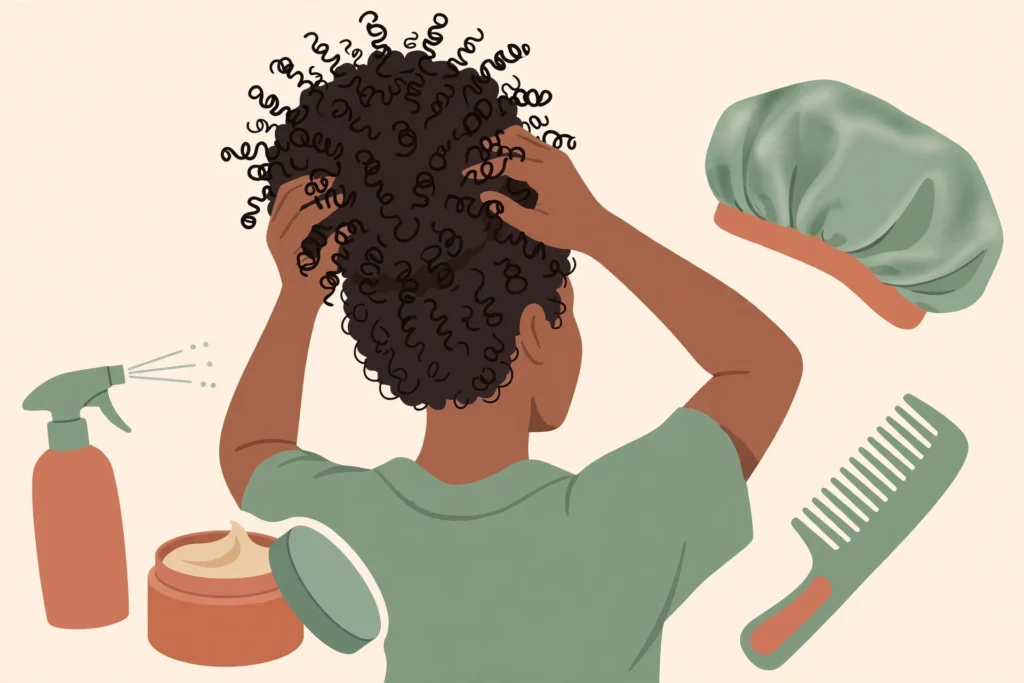
Work in sections for everything — washing, conditioning, detangling, and styling. Sectioning is the single habit that turns a frustrating wash day into a manageable one. Keep your tools simple: a wide-tooth comb, your fingers, sectioning clips, a satin bonnet, and a spray bottle will cover almost every step of a 4c hair routine.
Trim the ends every two to three months, or whenever you notice single-strand knots and split ends catching during detangling. And keep a simple note of what you used each wash day — which conditioner, how long you left it on, and how the hair felt two days later. Over a month or two, those notes reveal your hair’s real preferences better than any single product recommendation. For product ideas matched to this pattern, see our roundup of the best products for 4C coily hair.
Frequently Asked Questions
How long does a 4C hair routine take on wash day?
A full wash day usually takes two to three hours, including deep conditioning time. Most of that is waiting while the conditioner works. With practice and consistent sectioning, many people get it down to about ninety minutes. The refresh steps on other days take five to ten minutes.
Can I follow a 4C hair routine if my hair is short?
Yes. The same principles apply at any length: gentle cleansing, deep conditioning, wet detangling, layered moisture, and nightly protection. Shorter hair simply needs less product and less time per step.
How do I know if my 4C hair needs moisture or protein?
Hair that feels soft, limp, and overly stretchy usually needs protein. Hair that feels stiff, rough, and snaps easily usually needs moisture. When in doubt, moisturize first — most 4C hair is thirsty more often than it is protein-deficient, and a deep conditioning session is the safer test.
Is it okay to wash 4C hair more than once a week?
Yes, if your scalp needs it — for example after heavy sweating or swimming. Just keep the wash gentle, always follow with conditioner, and avoid detangling more often than necessary. Your routine is a framework, not a rigid schedule.
What is the best way to stretch 4C hair without heat?
Twist-outs, braid-outs, banding, and African threading are the most reliable heat-free stretching methods. Apply leave-in and cream to damp, sectioned hair, set the stretch, and let the hair dry completely before taking it down. Fully dry hair holds the stretch; damp hair springs straight back.