Walk into any curly hair discussion and you’ll hear numbers and letters flying around: 2B, 3C, 4A. This curl types 2A to 4C guide decodes the system — what each type looks like, how to figure out yours, and why the number is only half the story.
| Type | What it looks like | Needs most | Product weight |
|---|---|---|---|
| Wavy (2A-2C) | S-shaped waves between straight and curly; 2A waves are fine and easily weighed down, 2C waves are thick, coarse, and frizz-prone. | Lightweight care and more frequent washing; oil travels more easily down looser patterns. | Lightweight; mousses and light gels enhance waves, heavy creams flatten them. |
| Curly (3A-3C) | Defined curls and ringlets, from large, loose 3A curls to tight, dense 3C corkscrews with lots of volume. | Sulfate-free cleansing, generous conditioning, and styling on soaking-wet hair. | Generous conditioning |
| Coily (4A-4C) | Tight coils with the most shrinkage; 4A forms defined S-spirals, 4B has sharp zigzag angles, and 4C is densely packed with minimal defined pattern and maximum shrinkage. | Maximum moisture, gentle detangling, and protective nighttime routines with a satin bonnet. | Heavy; maximum moisture, LOC method for sealing |
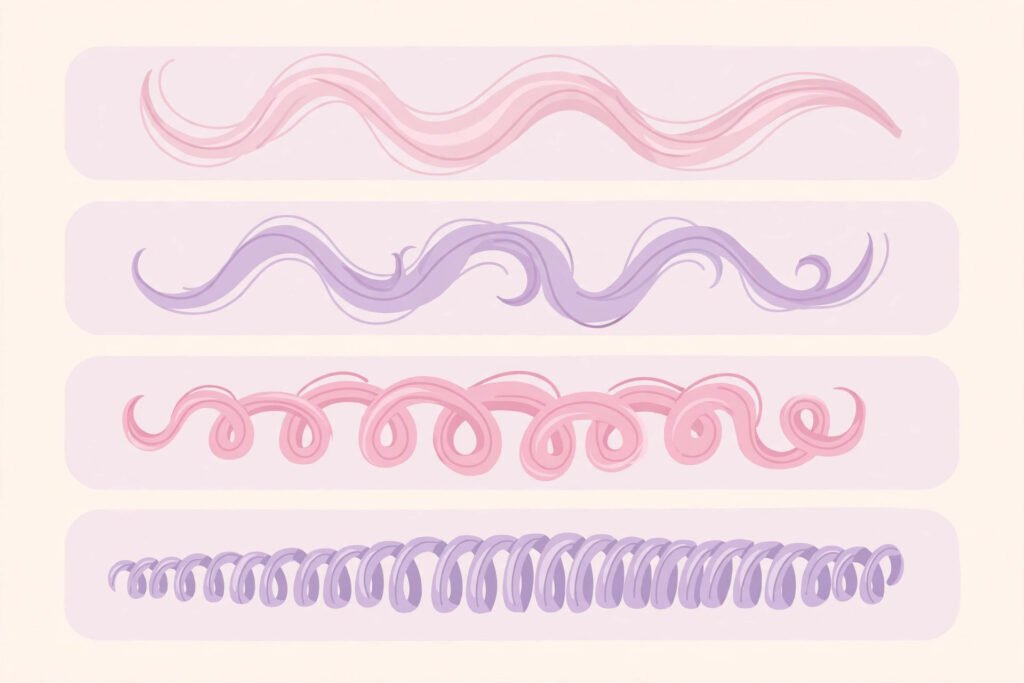
Table of Contents
The Curl Typing System, Explained
This curl types 2A to 4C guide groups hair into four families by curl shape, each split into A (loosest), B, and C (tightest) subcategories:
- Type 1: straight hair (not covered here — this guide is for texture).
- Type 2: wavy — S-shaped waves that get curlier from 2A to 2C.
- Type 3: curly — defined curls and ringlets, from loose 3A loops to tight 3C corkscrews.
- Type 4: coily — tight coils and zigzag patterns, from 4A spirals to 4C’s dense, shrinkage-prone texture.
For a visual walkthrough, see our curl type chart from 2A to 4C.
Type 2: Wavy Hair (2A–2C)
Wavy hair sits between straight and curly. 2A waves are fine and easily weighed down; 2C waves are thick, coarse, and frizz-prone. The golden rule for waves: lightweight everything. Heavy creams flatten waves, while mousses and light gels enhance them. Wash a bit more often than curlier types, since oil travels more easily down looser patterns — a point this curl types 2A to 4C guide returns to in the quick reference below.
Type 3: Curly Hair (3A–3C)
The classic ringlet zone. 3A curls are large and loose; 3C curls are tight, dense corkscrews with lots of volume. This range responds beautifully to the Curly Girl Method basics: sulfate-free cleansing, generous conditioning, and styling on soaking-wet hair. Techniques like plopping and the Denman brush technique shine here.
Type 4: Coily Hair (4A–4C)
Tight coils with the most shrinkage and the greatest need for moisture. 4A forms defined S-spirals; 4B has sharp zigzag angles; 4C is densely packed with minimal defined pattern and maximum shrinkage. Priorities: maximum moisture, gentle detangling (see how to brush without breakage), and protective nighttime routines with a satin bonnet. Our best products for 4C hair guide has tailored picks.
How to Find Your Curl Type
As this curl types 2A to 4C guide recommends, type on clean, product-free, air-dried hair — product residue distorts your true pattern. Most people have multiple patterns on one head (very common), so identify the dominant one and note the variations. Our detailed walkthrough on how to find your exact curl type covers the process, including why your pattern can seem to change with length, damage, or hormonal shifts.
Porosity Matters More Than the Number
Here’s what the charts don’t tell you: two people with 3B curls can need completely different routines if one has low porosity hair and the other has high porosity hair. Porosity determines which products absorb, how often to deep condition, and whether protein helps or harms. Learn it alongside your type, as this curl types 2A to 4C guide recommends — and keep the protein-moisture balance in mind.
How to Identify Your Exact Pattern: A Five-Step Framework
Typing your hair is a decision procedure, not a personality quiz. The steps below turn the chart at the top of this page into a working answer: each step narrows the possibilities until one pattern — or one dominant pattern — is left. Work through them in order, on a wash day, with a mirror and daylight. If two steps point to different letters, that is useful information: most heads carry more than one pattern, and Step 5 shows how to handle that.
Step 1: Start from a clean baseline
Wash with a gentle cleanser, condition, and rinse fully. Add no leave-in, styler, or oil, detangle only while wet, and let the hair air-dry untouched — no scrunching, brushing, or diffusing. Residue hides the true shape and handling reshapes it temporarily, so the dry, untouched result is the only honest baseline. Photograph it in daylight from the front, side, and back; comparing photos against the descriptions below is easier than judging wet hair in a mirror.
Step 2: Read the shape before the size
Ask three questions, in this order. Shape decides the family; loop diameter decides the letter, and starting with diameter is the most common reason people mistype themselves.
- Does the strand bend in loose S-curves without closing into a loop? That points to the wavy family.
- Does it close into loops or ringlets? That points to the curly family.
- Does it form tight coils, sharp zigzags, or no visible loop at all? That points to the coily family.
A stretched 3B curl can look like a 2C wave, and a shrunken 4A coil can look patternless — which is why shape comes first.
Step 3: Match the loop to everyday objects
Published descriptions commonly compare loop sizes to familiar objects. Use these as narrowing aids, not measurements.
- 2A: faint S-waves, fine in texture, easily weighed down; the wave shows mainly toward the ends.
- 2B: defined S-waves running through the length, medium texture, with some frizz at the crown.
- 2C: thick, well-defined waves with a few true ringlets underneath; the most frizz of the wavy group.
- 3A: large, loose loops, roughly the width of a wine cork, with a soft, shiny finish.
- 3B: springy ringlets roughly the width of a marker pen, with noticeable volume and bounce.
- 3C: tight corkscrews roughly the width of a pencil, densely packed, with the most volume of the curly group.
- 4A: small, defined S-shaped spirals roughly the width of a crochet needle or a pen spring.
- 4B: sharp zigzag angles rather than loops, with less visible clumping and more shrinkage than 4A.
- 4C: densely packed strands with no clearly defined loop, the tightest pattern in the system, and the most shrinkage.
If your hair sits between two descriptions, note both and let Step 4 break the tie.
Step 4: Run three distinguishing checks
For borderline cases, three observation methods described in curl-care guides help separate neighbours:
- The stretch check. Pull a single strand gently and release it. Waves return slowly to an S-shape, curls spring back into a loop, and coils snap back tightly or hold a zigzag — the return separates 2C from 3A and 4A from 4B better than looking alone.
- The wet-to-dry check. Note how much the pattern tightens as hair dries. Wavy hair often looks nearly straight when wet and gains its wave as it dries; coily hair shows its tightest pattern once fully dry. A large wet-to-dry change points toward the tighter end of your range.
- The root check. Look at new growth near the scalp, which past damage, colour, and heat have affected least. If the roots differ from the ends, the root pattern is the better guide to your natural type.
When two checks agree, that is your answer. When all three disagree, record the range (for example, “2B to 3A”) and decide care by the dominant pattern in Step 5.
Step 5: Map mixed patterns zone by zone
Most heads carry two or three patterns at once — looser at the nape, tighter at the crown, or the reverse. Divide the hair into three zones (crown, sides, nape/underneath), note the dominant pattern in each, and treat the majority pattern as your working type. Care follows the majority pattern, with small adjustments for the outlier zone: extra moisture on tighter sections, lighter product on looser ones. Re-map after major length changes, colour or chemical services, or about a year of growth.
The Pattern × Porosity Decision Framework
Pattern answers “what shape is my hair”; porosity answers “what does it absorb”. Two people with the same pattern can need different routines if their porosity differs, so the decisions below use both answers together. Low-porosity hair has a flat-lying cuticle: water and product sit on the surface, and it is slow to wet and slow to dry. High-porosity hair has a raised or damaged cuticle: it absorbs fast, loses moisture fast, and dries fast. The Best Products for Low Porosity Hair post explains the absorption side in detail. Read your row against your column for the starting decisions, then adjust from what your hair shows you over two to three wash days.
| Family | Low porosity: starting decisions | High porosity: starting decisions |
|---|---|---|
| Wavy (2A–2C) | Lightest weight; foam over cream; wash more often; clarify regularly | Lightweight plus a sealing step; leave-in with light gel; watch frizz from over-washing |
| Curly (3A–3C) | Lightweight but generous conditioning; style soaking wet; add heat to help absorption | Richer leave-ins and creams; layer leave-in, cream, then gel; seal and schedule protein |
| Coily (4A–4C) | Liquid leave-in first, then seal; warm water and longer deep-condition sessions | Richest routine; cream leave-ins, sealing oils or butters, layering, protective styles |
Wavy hair (2A–2C): light products, adjusted for porosity
Product weight. Waves need the lightest touch of any family. For low-porosity waves, watery leave-ins and foams suit best — Curlsmith Bouncy Strength Volume Foam is an example in this weight class — while heavy creams and butters flatten the pattern. For high-porosity waves, keep the light base but add a sealing step, such as a light gel over leave-in, to slow moisture loss.
Wash approach. Oil travels more easily down looser patterns, so waves usually need washing more often than curlier types, and low-porosity waves need regular clarifying because buildup sits on the surface and pulls waves flat. The L’Oréal Paris EverPure Curl Shampoo + Conditioner set is an example of a lightweight, sulfate-free wash.
Styling approach. Style on damp rather than soaking-wet hair, using mousse or a light gel — the Olaplex Nº 10 Bond Shaper Gel is an example in this class — then scrunch and diffuse on low heat or air-dry without touching. The full routine is laid out in the Wavy Hair Care Routine.
Common mistakes. Heavy creams on fine waves; styling on soaking-wet hair; stretching wash days until buildup flattens the pattern; brushing dry waves, which breaks wave clumps apart.
Curly hair (3A–3C): definition first, weight matched to porosity
Product weight. For low-porosity curls, condition lightly but generously: plenty of conditioner on soaking-wet hair, with warmth (warm water, or heat during a deep-condition session) to help it absorb. For high-porosity curls, move richer — cream leave-in, then styler, then a sealing layer — with protein scheduled rather than daily. The protein-vs-moisture balance explains how to judge when protein helps and when it stiffens.
Wash approach. Cleanse with a sulfate-free wash, condition generously, and deep condition on a regular schedule, with the frequency set by porosity: high-porosity curls usually need it more often. The OBIA Naturals Babassu Deep Conditioner is an example of a deep conditioner in the range featured on this site.
Styling approach. Style on soaking-wet hair: apply leave-in, then cream or gel, then define clumps by finger-coiling or brush styling — the Denman D3 Classic Styling Brush is the brush the technique guides on this site describe for that step — then plop and diffuse or air-dry. Stylers in this weight class include Moroccanoil Curl Defining Cream and Not Your Mother’s Curl Talk Leave-In. The step-by-step routine is in the Curly Hair Care Routine.
Common mistakes. Brushing dry curls; styling with too little water; heavy products on fine 3A hair; skipping deep conditioning on dense 3C hair; using protein daily when the hair is already stiff.
Coily hair (4A–4C): maximum moisture, gentle handling
Product weight. Coils need the most moisture of any family, but weight still follows porosity. For low-porosity coils, start with a liquid leave-in on wet hair and seal afterwards — heavy product on dry, low-porosity hair sits on the surface. For high-porosity coils, use the richest routine: cream leave-ins, sealing oils or butters, and layered application (liquid, cream, sealant) to slow moisture loss.
Wash approach. Detangle only when the hair is wet and saturated with conditioner, working section by section from the ends. Co-washing between shampoo days suits some routines; the As I Am Coconut CoWash and Leave-In set (a duo set: 16 oz cleansing conditioner plus 8 oz leave-in) is an example of a co-wash product featured here. The Head & Shoulders Royal Oils Moisturizing Shampoo is an example of a wash the brand describes as made for natural, curly, and coily hair. For gentle drying, the TURINGCREST Microfiber Hair Towel Wrap is an example of a microfiber wrap featured here.
Styling approach. Definition methods include twist-outs, braid-outs, shingling, and finger-coiling, with heatless stretching such as banding to reduce shrinkage before styling. Protective styles reduce daily manipulation, and a satin bonnet at night protects the pattern and moisture balance. The full routine is in the Coily Hair Care Routine.
Common mistakes. Detangling dry hair; skipping the sealing step; heavy-handed brushing; washing without sectioning; neglecting nighttime protection, which costs the most moisture.
Putting the Framework to Work: Two Worked Examples
Example A — 2B waves, low porosity. The framework points to the lightest weight class, more frequent washing, regular clarifying, and styling on damp hair with foam or a light gel. The decision to watch is buildup: if waves fall flat by day two, the usual cause is product sitting on the surface — the answer is to clarify and lighten the leave-in, not add more product.
Example B — 4C coils, high porosity. The framework points to the richest routine: cream leave-in, layered sealing, gentle sectioned detangling on wet hair, and protective styling. The decision to watch is moisture loss: if coils feel dry within a day of washing, the answer is to strengthen the sealing layer and shorten the gap between moisture sessions, not to wash more often.
In both cases the same two questions — which family, which porosity — produce different routines from the same chart. That is the point of typing: not the label itself, but the decisions it lets you make.
Caring for Your Type: Quick Reference
- Waves (2A–2C): lightweight products, more frequent washing, mousse over cream.
- Curls (3A–3C): the classic curly routine — beginner’s routine is your blueprint; refresh with day 2 refresh techniques.
- Coils (4A–4C): heavy moisture, the LOC method for sealing, protective styles, gentle tools (see detangling brushes).
Choosing stylers? Gel vs mousse vs custard matches hold to texture — a choice this curl types 2A to 4C guide ties directly to your pattern. Drying method matters too: diffusing vs air drying.
Frequently Asked Questions
Can I have more than one curl type?
Almost everyone does. As this curl types 2A to 4C guide notes, it’s completely normal — type the majority pattern and adjust products for the outliers (e.g., extra moisture on the tighter sections).
Does curl type change over time?
Yes. Length, damage, coloring, hormones, and even seasons can shift your pattern. Re-check yearly, and read what to expect when transitioning if you’re growing out damage.
Is 4C hair “harder” to care for?
It needs more moisture and gentler handling, but “harder” is the wrong frame — it’s simply different, which is why this curl types 2A to 4C guide gives coils their own care priorities. With the right routine, 4C hair is incredibly versatile. Start with our 4C product guide.
Do I need different products for each type in my household?
Often just different stylers and leave-ins. Cleansers and deep conditioners can usually be shared; it’s the styling and sealing step that varies most by type.
Sources
- American Academy of Dermatology — “Tressed to impress: tips for keeping your mane magnificent” — https://www.aad.org/news/tressed-to-impress-hair-tips
- American Academy of Dermatology — “6 curly hair tips from dermatologists” — https://www.aad.org/news/6-curly-hair-tips-from-dermatologists
- Gavazzoni Dias, Maria Fernanda Reis. “Hair Cosmetics: An Overview.” International Journal of Trichology, 2015; 7(1): 2–15 — https://pmc.ncbi.nlm.nih.gov/articles/PMC4387693/